Blog post
From the Seine to the Rhine: Lutetia hulls on the Rotterdam and Duisburg runs
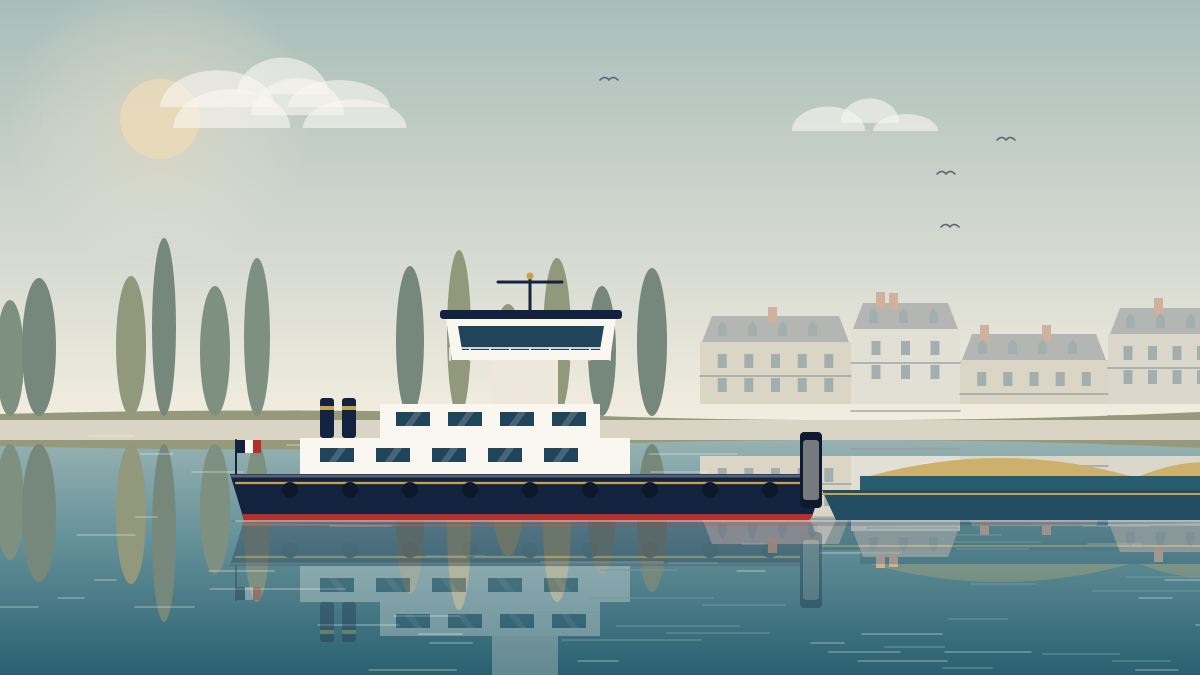
I work from our small office in Rotterdam, looking out over a port where inland barges outnumber sea ships many times over. Every day thousands of tonnes of containers, coal, grain and chemicals leave the port by water, heading up the Rhine to Duisburg, the largest inland port in Europe, or across to Antwerp and on into France. Operators here are practical people. They do not care about a boat's story; they care about what it costs per tonne and whether it arrives on time.
The Bastion Pusher is the hull they ask about most. It is a 22 metre push boat built to move convoys of barges lashed together, with a crew of four, a range of 1,200 km and a top speed of 15 km/h. It runs on a diesel-electric hybrid system using HVO, and at around 30 kWh per km under heavy load it is the most powerful boat we build. On the Rhine, where currents are strong and convoys can be large, the hybrid system lets the pusher use its full power upstream and run more efficiently going down.
The Seine Bulk 110 is the newer arrival. It was designed for the Seine between Le Havre and Paris, but its 1,800 km range and 2,600 tonne capacity make it interesting for the Rhine too. The big question is hydrogen supply. Rotterdam and Duisburg are both building bunkering facilities, and several operators are watching our French fleet closely before committing. For shorter, smaller flows, particularly into the Belgian and northern French canals, the Canal Carrier 38 with its 350 tonne capacity is often the right size.
My colleague Inês Carvalho in Antwerp handles the partner side, and together we spend a lot of time explaining that electric and hydrogen barges do not need a new way of working. The crews, the routes and the cargo stay the same. What changes is the fuel bill, the noise in the wheelhouse and the paperwork for emissions reporting, which is becoming more important as cities along the Rhine tighten their rules.
Next year we expect the first Seine Bulk to run regularly between Rotterdam and Duisburg under charter to a Dutch operator, with refuelling at both ends. If it works as well as it does on the Seine, more will follow. For a company that started out repairing steamers on the Seine in 1889, seeing our hulls on the Rhine feels like a natural next step. The rivers are connected; so is the business.