Blog post
Parking without the drama: inside our docking assist cameras
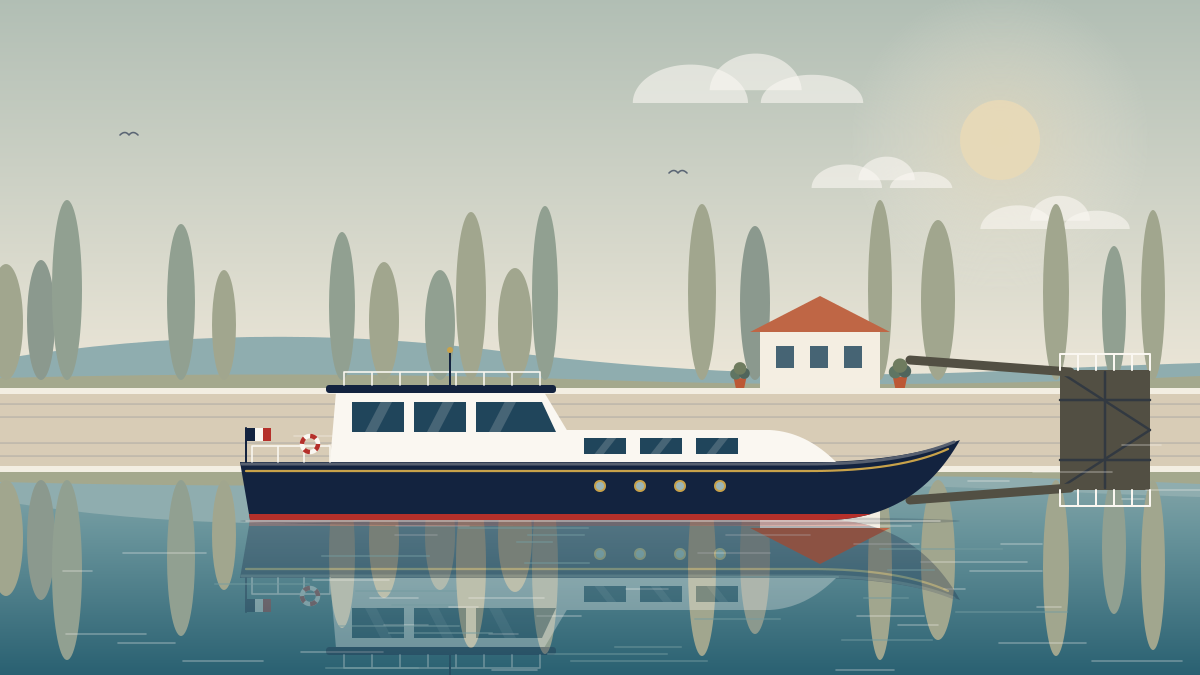
Ask any skipper which part of a trip makes their palms sweat and most will say the last ten metres. Out on the river, a boat is forgiving. Next to a stone quay, with a crosswind, a current and a crowd of people watching from a café terrace, it is not. Docking assist started as a project to make life easier for the crews of our river buses, and it is now fitted to almost every hull we build, from the Kingfisher 8 to the Heron 12.
The hardware is straightforward. Each boat carries a ring of wide-angle cameras along the hull, short-range ultrasonic sensors at the bow and stern, and a satellite positioning receiver accurate to a few centimetres. The cameras are mounted high and angled down, so they see the waterline, the fenders and the edge of the quay at the same time. The helm screen stitches the images into a single bird's-eye view, with the boat drawn in the middle and the distance to the nearest obstacle shown in metres.
The software is where the work went. Water reflects light, quays are often in deep shadow under bridges, and rain and spray land on the lenses. Mei-Lin Zhou's team trained the image processing on thousands of hours of footage from the Seine, recorded in every season and at every time of day. The system now recognises quay edges, bollards, ladders, moored boats and swimmers, and it warns the skipper long before any of them get close. Everything is processed on board; the footage never leaves the boat unless an owner chooses to share it with us.
On the Pont Shuttle 24, which makes dozens of stops a day, the system goes one step further. The skipper lines the boat up roughly and presses a button, and the controller uses the thrusters and propellers to hold the shuttle gently against the pontoon while passengers board. Crews tell us it saves energy too, because the boat no longer wastes power correcting small drifts. On smaller boats, the assist is advisory: it shows the picture and the distances, sounds a tone as you approach and can hold the boat steady for a moment while you step off with a line.
We are careful about one thing: the skipper stays in charge. Docking assist does not take decisions about where to go or when to leave. It gives a clearer view of what is around the boat and helps with the fine control that is hard to judge by eye. For solo skippers in particular, it turns a two-handed job into a calm one. If you want to try it, every demonstration sail from the Quai de la Rapée includes a few practice approaches.