Blog post
Gentle on the quays: how we design hulls that make less wash
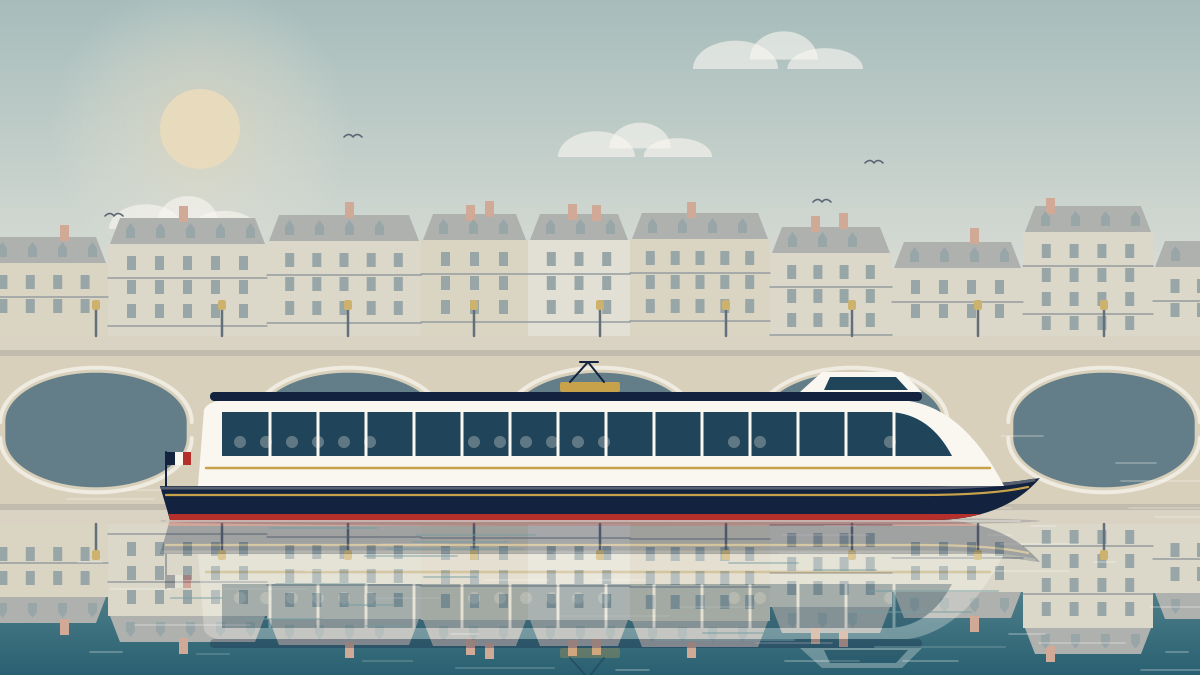
If you stand on the Pont Neuf on a summer afternoon and watch the river, you will see dozens of boats pass beneath you. Each one leaves a wake, and each wake travels to the banks. In central Paris those banks are stone quays built centuries ago, lined with houseboats, cafés and swimmers. Wash damages walls, rocks moored boats and makes life unpleasant for everyone on the water. That is why low wash is one of the first lines in the brief for every hull we design.
The physics is simple to state and hard to master. A boat moving through water makes waves at the bow and the stern. The faster it goes relative to its length, the bigger those waves become, until a point where the hull is effectively climbing its own bow wave. A longer, slimmer hull can go faster before that happens. So the first rule is to make the waterline as long and as fine as the boat's use allows. The Pont Shuttle 24 is 24 metres long but narrow for its capacity of 120 passengers, which keeps its wash small at 20 km/h.
The second rule is to shape the stern carefully. A transom that is too wide or too deep drags a hole in the water behind it, and that hole becomes a large stern wave. Noah Girard spent months in the towing tank refining the run of the hull aft, so that water leaves the stern smoothly. The Gondola Water Taxi, a 10 metre boat with room for 12, has a narrow, rounded stern for the same reason, and at its top speed of 20 km/h it barely disturbs the reflections along the Canal Saint-Martin.
The third rule is weight. Every extra tonne pushes the hull deeper and makes a bigger wave. That is one reason we take battery placement so seriously: putting the cells low and central keeps the boat level, so it does not squat at the stern when it speeds up. On the Grand Salon 38, which carries up to 350 dining guests, we worked with the interior team to spread the weight of the galley, bar and glass roof evenly along the hull.
Finally, we measure. Every new hull runs past wave probes on a measured course near Rouen, and we publish the results. We also give skippers a wash indicator on the helm screen, which shows when the boat is making more wave than it needs to. The best hull in the world still makes a mess at the wrong speed, so in the end low wash is a partnership between the designers and the people at the wheel.